Laser Marking Additives, Laser-Sensitive Additives

Laser Marking Plastics Additives - Industrial Lasers

Laser marking plastics additives and colorant compounds, by The Sabreen Group, optimize the process of laser marking and engraving on plastic materials, making them environmentally friendly and ideal for replacing expensive labels, and ink printing processes. Laser-sensitive additives not only increase marking quality, but they also produce chemical and scratch-resistant markings and improving material flow. Recent breakthroughs in colorant technology, such as laser-specific carbon blacks and titanium dioxides, as well as foaming agents, provide superior contrast quality, line edge detail, customized colors, and the fastest speed, including “on-the-fly” marking. Industrial nanosecond MOPA Ytterbium fiber lasers are ideal for marking plastics because of their capability to produce short pulse width waveforms.

Laser Marking Additives and Colorants Increase Production Speed and Save Money

  • Superior Marking Quality, abrasion/scratch-mar resistant
  • Robust machine vision codes read readability
  • Six Sigma process control

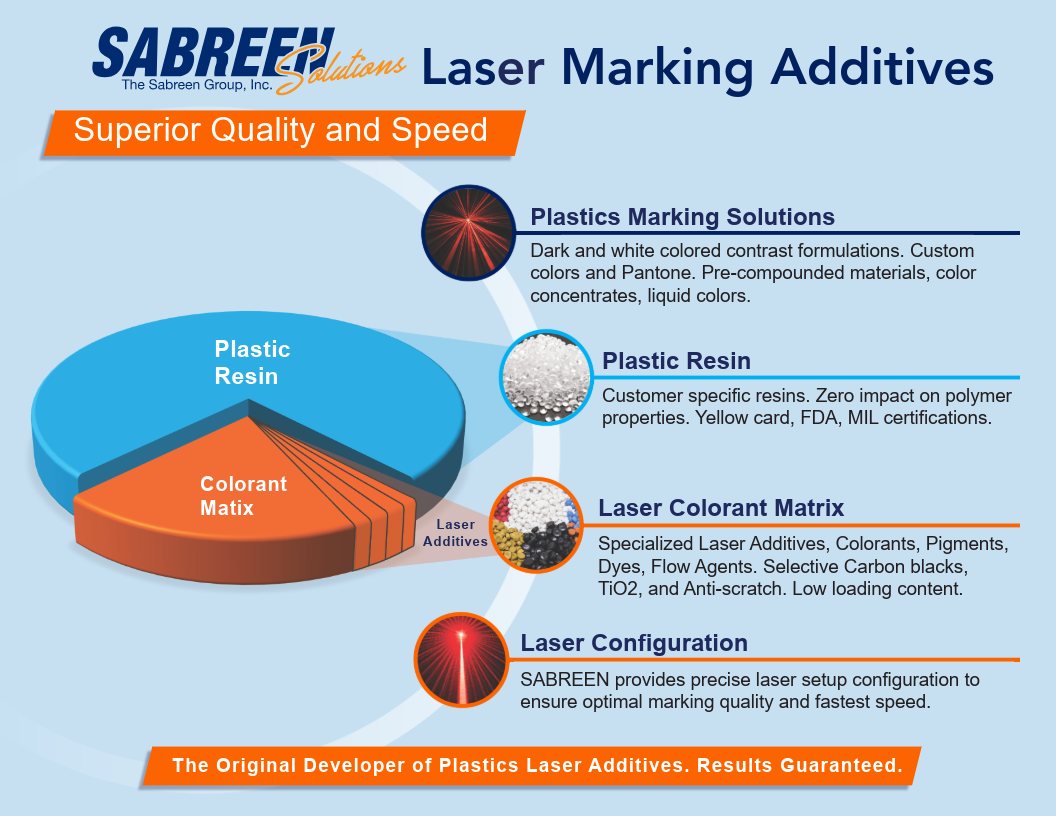
A laser colorant matrix contains specialized additives, pigments, dyes, selective carbon blacks, titanium dioxide, and anti-scratch agents at low loading content. Precompounded materials, color concentrates, and liquid colors are sold. There is zero impact on polymer properties, and Recertification is not needed due to industry approved chemistries. Yellow card certification. Laser additives, compounds, and colorants are compliant with FDA, UL, NEMA, RoHS.

Laser Optimized Plastics Versus Conventional Plastics

Not all “laser optimized” materials necessitate the use of additional chemicals, sometimes known as laser-sensitive additives.

When marking conventional parts, a common problem is high concentrations of colorants, such as carbon black, which impair marking contrast. Experts adjust the concentrations to keep within critical thresholds while also making final color adjustments to ensure color match based on the laser wavelength, Near-infrared 1060-1070nm, Green 532nm, or UV355nm. In these cases, the products retain their industry certifications. Laser additives are not necessary in all applications for better marking quality. When modifying conventional plastics to improve marking is insufficient, laser-sensitive combined into a colorant matrix are utilized. Contrary to popular belief, no single additive can resolve all of the marking issues. Single additives are often in powder form, which makes them difficult to use and achieve uniform results.

Polymeric Laser Marking Surface Mechanisms 

The most popular laser types for marking and engraving plastics are Ytterbium fiber, Vanadate, DPSS, and YAG, which operate in the near-IR region (1060-1070nm). Most polymers, however, lack absorption properties at 1060-1070nm; thus, experts in polymer science and laser physics use additives, fillers, pigments, and dyes that increase laser energy absorption for localized color changes, thermal carbonization, and chemical foaming. When properly blended, laser marking additives, compounds, and colorants have no adverse impact on polymer properties, meet requirements such as UL, NEMA, FDA, RoHS and Yellow Card, and do not require recertification. The chemical components of laser optimized formulations are influenced by a number of factors, including polymer type and color, marking contrast color, surface reaction mechanism type, and laser wavelength. 

Four different plastic surface mechanisms produce varied degrees of marking contrast relative to the substrate color – light, dark, and custom colors. These surface reactions can be further optimized by adjusting the laser marking parameters and optical setup, such as pulse width, spot size, collimation, power density, focus depth, and so on. By controlling the laser source and the temperature rise and fall of the polymer surface produces the most robust marking results.  

  1. Carbonization ‘charring’. The charring reaction occurs when the energy absorbed elevates the local temperature of the material surrounding the absorption site to a point where the polymer undergoes thermal degradation. In the presence of oxygen, the polymer burns; but, within the work piece, a lack of oxygen causes the polymer to char and form a black mark. The mark’s blackness is determined by both the amount of energy absorbed and the material’s thermal degradation pathway. 
  2. Chemical change ‘foaming’. The addition of additives that release steam during degradation causes the polymer to foam. During the foaming process, the laser energy is absorbed by an additive that is in close proximity to the foaming agent. The heat from the absorber causes the foaming agent to degrade, releasing steam. Foaming agents include aluminum hydroxide and different carbonates. To avoid charring, the mechanism requires the polymer to degrade at a higher temperature than the foaming additive. High quality light contrast marks on dark substrates can be achieved by carefully controlling the laser operating parameters. Poor laser control can cause the formation of a friable or low contrast mark. 
  3. Color change by degradation. Color change occurs when laser energy degrades one colorant in a colorant mixture, producing a color change. Carbon black mixed with a stable inorganic colorant is one example. When heated, the carbon black evaporates, leaving the inorganic colorant behind. 
  4. Ablation occurs when the polymer is heated sufficiently to cause degradation and evaporation of the degradation by-products, resulting in an etched area. This mechanism produces low contrast, engraving. As reference, the continuous wave (CW) CO2 lasers operate at a wavelength of 10.6 µm (far infrared spectrum). CW CO2 lasers generate comparatively much lower peak power and normally cannot produce high contrast markings on plastics. 

Not All Plastics and Lasers Produce Identical Marks! 

Many well-known industrial products could not have been manufactured at an affordable cost without the usage of industrial lasers and SABREEN’s advanced laser-markable compound solutions. From functional and decorative indelible markings to anti-counterfeiting and product security, laser markable masterbatch compounds save costs while enhancing marking quality and speed. With so much ambiguous terminology on the internet, such as “cold laser marking” and “hybrid lasers”, as well as competition among low-cost laser equipment resellers and manufacturers, don’t let equipment biased salespeople tell you which type of laser to buy from their offerings; they are not polymer and colorant experts.  

Contact The Sabreen Group to learn how our advanced plastic laser marking solutions and precise laser configuration settings, which include the most effective laser wavelength source, can provide your company gain a competitive advantage. 

keyboard
car key imprint
laser engraving
syringe plunger
medical tubing
ear tag
polypropylene
Avatar

Scott Sabreen
President & Chief Engineer
30+ Years of Expertise

To arrange a teleconference with Scott Sabreen, please fill out the information below.

What is your mailing address?

Topic of interest?

What industry are you in?

What is the primary plastic type?

Submission Successful!

Your message has been received. We will be in touch shortly to arrange a meeting time.

We Have Received Your Request

We have received your request and will be in touch shortly.