



Further reading on additives and masterbatch
Frequently Asked Questions
What does a laser marking additive actually do?
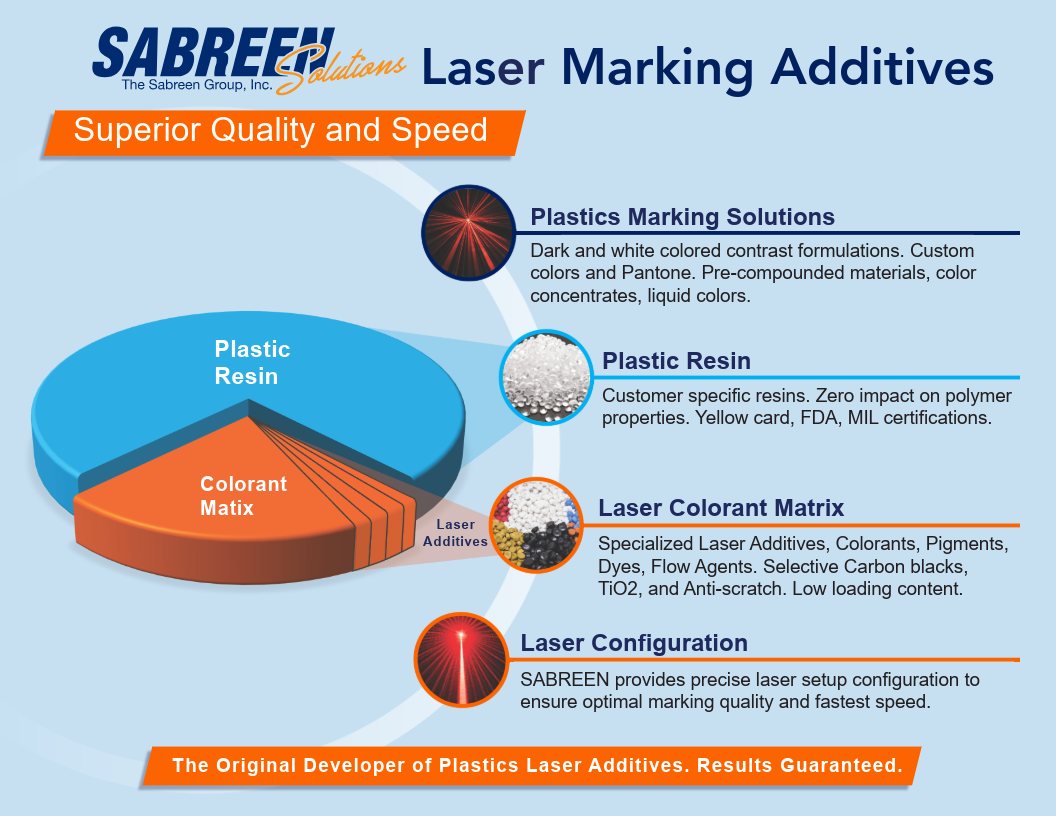
It makes the resin respond to laser energy in a controlled, repeatable way at the wavelength being used -- producing contrast where the base polymer would produce little or none, or allowing an acceptable mark at lower energy than the unmodified resin needs. It changes what the material does under the beam, rather than changing the laser.
How is the right additive selected?
Against four things at once: the resin, the part color, the laser wavelength available, and the contrast and durability the application requires. An additive that performs well in natural polypropylene at 1064 nm may do nothing useful in a pigmented polycarbonate under a CO2 source. Selection is a matching exercise, and testing against the production resin is what settles it.
Will a laser additive change the color or properties of the part?
It can, which is why it is evaluated alongside color development rather than after it. Loading levels are kept to what the marking requires, and the candidate additive is assessed for its effect on appearance and on the mechanical and regulatory properties the part has to meet.
Are FDA-compliant laser additives available?
Yes. FDA-compliant additives are documented in use on polyolefin medical syringes, on medical tubing for invasive surgical procedures, and on linerless beverage closures marked on the fly at 2,000 closures per minute. A jet black additive is also documented that does not contain heavy-metal antimony-tin oxide.
What is the difference between an additive and a masterbatch?
The additive is the active chemistry; a masterbatch is that chemistry pre-dispersed in a carrier resin at a known concentration so it can be metered into production. In practice you specify the additive for performance and buy it as a masterbatch for handling, with the let-down ratio becoming a process parameter.
